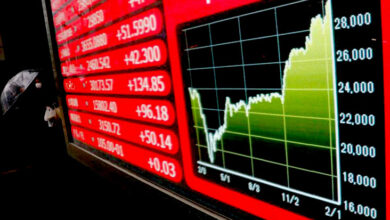
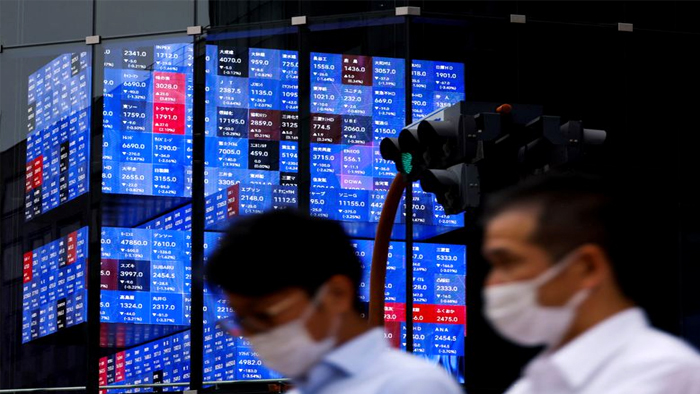
Most Asian stock markets went up on Friday, and most were on track for big gains for the week. This was because data showed that U.S. consumer inflation went down in December, as expected. This could mean that the Federal Reserve will be less aggressive this year.
Taiwan, South Korea, and Hong Kong’s stock markets, which have a lot of technology-related stocks, were among the ones that did the best this week. This was because Treasury yields and the dollar went down because of the low inflation reading. This week, the KOSPI, Hang Seng, and Taiwan Weighted indexes were all expected to gain between 2.8% and 4.4%, but the KOSPI was expected to gain the most.
Related: Asia stocks went up because of bets on the Fed rate, and the yuan went up because China reopened.
On Friday, all three indexes went up by between 0.3% and 1%.
After China reopened its borders to the rest of the world for the first time in three years, investors grew more hopeful about the country’s economy. This made Chinese stocks go up. The Shanghai Shenzhen CSI 300 and Shanghai Composite indexes both went up by 0.8% and 0.6%, and they were on track to go up for a third week in a row.
The country’s trade balance also grew faster than expected, according to data released on Friday. This, along with a small rise in prices in December, showed that economic growth was getting better after most COVID lockdowns were lifted.
Asian markets as a whole were up, and stocks with a lot of risk, like those in Southeast Asia, did very well. With a 1.4% rise, stocks in the Philippines did the best of any country in the region.
Consumer price index inflation in the U.S. fell in December, as expected. This makes it less important for the Federal Reserve to keep raising interest rates quickly.
This is likely to mean that the risky Asian markets will feel less pressure this year. Traders now think there is a nearly 95% chance that the Fed will raise rates by 25 basis points in February.
But even though interest rates are expected to reach their highest point this year, the markets are also worried about a possible recession, especially as the effects of tight monetary policy become clearer. If growth in major economies slows down, it could be bad news for markets that are based on taking risks.
On Friday, Indian stocks went against the trend. The Nifty 50 and BSE Sensex 30 fell 0.3% and 0.1%, respectively, as data showed that CPI inflation stayed the same in December. The Reserve Bank may have to raise interest rates again because of the trend.
Related: Asia’s equities increase as China reopens, counteracting worries over U.S. payrolls.
Australia’s ASX 200 index went up by 0.7%. This was mostly due to big mining stocks, which were helped by the hope that Chinese demand would pick up. Shares of BHP Group Ltd. (ASX:BHP), the biggest mining company in the world, went up 0.5% to a new record high.