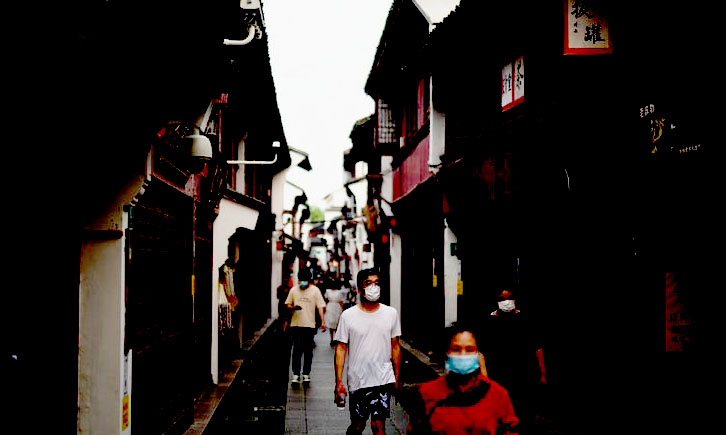
Shanghai (Reuters) – Temperatures and stress levels both went up in Shanghai on Wednesday, when medical workers wore hazmat suits and sweated while giving mandatory COVID-19 tests to a city that had just come out of a two-month lockdown.
Since a week ago, dozens of new cases of infection have been reported every day in China’s commercial hub. Even though the numbers aren’t that high, this has scared many of the city’s 25 million residents, who had to deal with the lockdown in April and May.
Daytime temperatures of about 40 degrees Celsius (104 degrees Fahrenheit) added to the tense mood of a population that fears the mental and financial costs of going through this again.
Personal trainer Ying Jie said that even if there isn’t another lockdown in Shanghai, he plans to close his gym for good, just one year after opening it, because he can’t handle the uncertainty anymore.
Due to the outbreak, gyms in some parts of the city, including Ying’s, have been told to stop working this week.
Ying said, “We were open from July 1 to July 10.” “I can’t not pay rent, but I can’t operate. If I open my gym in secret and good things happen there, I’ll lose my license. There is too much chance of getting fined. “
Most big countries are choosing to live with the virus, but China has a policy called “dynamic zero-COVID” that tries to stop outbreaks as soon as they start. This is hurting its economy, though.
The best chance for success for the government is constant screening and targeted isolation orders. So far, these orders have been given to hundreds of homes and businesses.
Early this year, lockdowns in Shanghai and other places hurt the world’s second-largest economy, sending shockwaves through global supply chains and international trade.
Even though China’s foreign trade went down in April and went up in May and June, the future is still uncertain, said Li Kuiwen, a spokesman for the General Administration of Customs.
ESCAPE PLANS
Even though they have warned about the dangers of the highly contagious Omicron BA.5.2.1 subvariant, city officials have repeatedly shot down talk of wider restrictions.
All 55 new local cases that were reported on July 12 were found in people who were already under orders to stay away from other people.
But a lot of people are stocking up on basic supplies in case the worst happens.
“Right now, there’s no sign that they’ll lock down our neighborhood. But there were no clues the first time either, “Israeli business consultant Omri Hephner said this.
“This time, I’ll get out of Shanghai as soon as I can, no matter what I see,” Hephner said. He added that he planned to go to Beijing, then back to Israel, and wouldn’t go back to China until COVID policies were changed.
Overall, mainland China reported 261 new COVID cases that were spread within the country on July 12, compared to 347 the day before.
Analysts at Nomura think that COVID limits will be put in place in more than 30 cities.
On July 12, 69 local cases were reported in the province of Gansu in the northwestern part of China. On Wednesday, the city of Lanzhou, which has more than 4 million people, said that for the next seven days, only one person per household will be allowed to leave their residential compound to get groceries. Workers who aren’t essential can’t go to the office.
In the central province of Henan, key urban areas in the city of Zhumadian went into lockdown on Tuesday. Residents could only leave for COVID tests, trips to the hospital, and shopping for basic necessities.
The rules came after the town of Qinyang, which is in Zhumadian’s jurisdiction, put its almost 700,000 residents on an indefinite lockdown on Sunday.
Infections have also been found in the eastern provinces of Shandong and Jiangsu and in the southern province of Guangdong.