
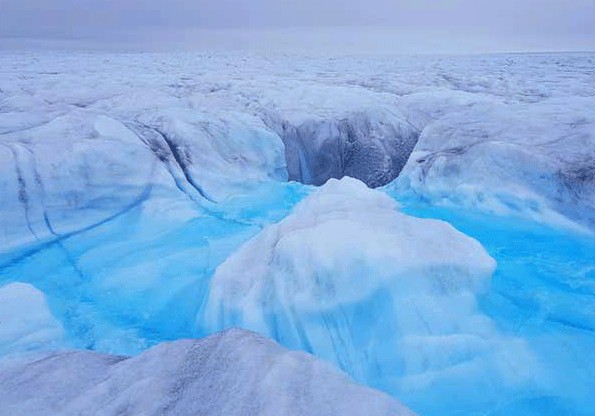
Cambridge, UK: New research suggests that Greenland’s ice sheets are melting faster from the bottom up, and that the accumulation of water there could accelerate the melting of the entire ice sheet and raise global sea levels.
The total area of Greenland’s ice sheets is 50,000 square kilometers, but its depth is still unknown, and that is why it has not been modelled and mapped.
Now Paul Christopherson of Cambridge University and his colleagues have devised a way to determine the melting of Greenland’s ice roots. It is also the second largest ice sheet in the world. Scientists have dug fourteen millimetres to find out its depth and condition with the help of a laser.
Paul found that the water flowing just below each vertical gap was 100 times faster than the old estimate and had a speed faster than direct sunny ice. There are two reasons for this, firstly, the water from above is accumulating at the bottom, warming up and melting more ice, and secondly, the ice is also melting by gravity.
It turned out that Iceland’s ice sheet was melting from below. According to experts, the melting of Iceland’s ice could raise the level of the global oceans, and its melting is playing the most important role. Under the same model, the melting speed of ice can be just as fast wherever there are ice layers like Iceland.
Experts have expressed concern over this and warned of rising sea levels.