


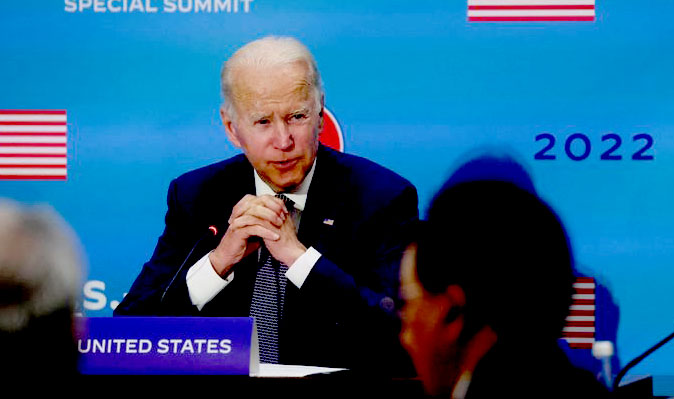
Washingto , U.S. Vice President Joe Biden said that the first summit with leaders from the Association of Southeast Asian Nations (ASEAN) in Washington marked the start of a “new era” in the relationship between the U.S. and the 10-country bloc.
In a 28-point “vision statement” they made together after a two-day meeting, the two sides took what analysts called a “symbolic step” by agreeing to change their relationship from a “strategic partnership” to a “comprehensive strategic partnership” in November.
Regarding Ukraine, they said again that they “respect sovereignty, political independence, and territorial integrity.” A regional expert said that this went further than previous ASEAN statements. Russia was not called out by name for its invasion on February 24.
The summit was the first time that ASEAN leaders met as a group in Washington. It was also the first time that a U.S. president had hosted a meeting of ASEAN leaders since 2016.
Even though Russia invaded Ukraine, Biden’s administration hopes that this effort will show that the U.S. is still focused on the Indo-Pacific and the long-term challenge of China, which it sees as its main competitor.
He also wanted to get ASEAN countries to take a stronger stand against Russia’s invasion of Ukraine.
Biden told the leaders of the ASEAN countries, “A lot of our world’s history will be made in the ASEAN countries over the next 50 years, and our relationship with you is the future for the years and decades to come.”
Biden called the partnership between the U.S. and ASEAN “crucial” and said, “We’re starting a new era in U.S.-ASEAN relations.”
Vice President Kamala Harris said that the U.S. would stay in Southeast Asia for “generations.” She also said that it was important to keep the freedom of the seas, which the U.S. says is being threatened by China.
Harris said, “The US and ASEAN share a vision for this region, and together we will protect international rules and norms from threats.”
Neither she nor Biden used the word “China.” The US has said that China is forcing its neighbors to do what it wants.
Harris said that Washington would keep working with ASEAN to deal with the threat of COVID-19. Washington has already given the region more than 115 million doses of vaccine. She said that both sides needed to show that they were serious about climate change, speed up the switch to clean energy, and meet infrastructure needs in a way that was good for the environment.
Brunei, Cambodia, Indonesia, Laos, Malaysia, Myanmar, the Philippines, Singapore, Thailand, and Vietnam are all members of ASEAN. Due to a coup last year, Myanmar’s leader was not allowed to attend the summit. The Philippines, which is a treaty ally of the U.S., was in transition after an election, so its foreign minister went to the meeting to speak for the country.
Thursday, Biden held a summit dinner at the White House. His administration promised $150 million for infrastructure, security, pandemic preparedness, and clean energy, among other things.
Rivalry with China, but shared worries
As part of its new commitments, the U.S. will send a Coast Guard ship to the area to help stop what the U.S. and other countries in the area call China’s illegal fishing.
Still, U.S. spending isn’t even close to what China is doing. In November, China promised ASEAN $1.5 billion in development aid over three years to fight COVID and help the economy recover.
On Friday, Biden announced that Yohannes Abraham, the chief of staff for his National Security Council, would be the next ambassador to ASEAN. This would fill a position that has been empty since Donald Trump took office in 2017. Biden is also working on “Build Back a Better World” infrastructure investments and an Indo-Pacific Economic Framework (IPEF).
Gregory Poling, an expert on Southeast Asia at the Center for Strategic and International Studies in Washington, said that the summit was mostly about symbols and didn’t have much to do with economics because IPEF won’t start until Biden goes to Japan in May.
“The diplomatic message of commitment is getting through, and everyone seems to be happy. But, to put it nicely, a modest $150 million won’t impress anyone “he said. “This means that a lot depends on IPEF.”
Changing the relationship to a full strategic partnership was like what ASEAN did with China and Australia last year.
Poling said, “That’s a big deal in terms of what it means, but it wouldn’t change much in real life.”
He pointed out that the statement about Ukraine didn’t say anything bad about Russia by name, but he said, “The call to respect Ukraine’s sovereignty, political independence, and territorial integrity is an obvious criticism of Russia, and it seems like all the ASEAN leaders would agree to never recognize any Russian annexation of Ukraine.”
ASEAN countries share many of the U.S.’s worries about China’s assertiveness, such as its claim of sovereignty over large parts of the South China Sea where other countries also have claims.
However, they are still hesitant to side more strongly with Washington because they have more economic ties with China than with the U.S. Some, like Vietnam, Laos, and Cambodia, still have ties to Russia from the past.
Since Trump left a regional trade pact in 2017, the U.S. has been slow to explain its plans for economic engagement, which has frustrated ASEAN states. At a virtual summit with ASEAN leaders in October, Biden told them about the plan to create IPEF.
Analysts and diplomats say that Singapore and the Philippines are the only two ASEAN countries that are likely to be part of the first group to sign up for negotiations under IPEF. This is because IPEF does not currently offer the expanded market access that Asian countries want because Biden is worried about American jobs.