


On Wednesday, Chief Justice of Pakistan (CJP) Justice Umar Ata Bandial stated that loyalty is a fundamental principle of the constitution, noting that Article 63(A) links loyalty to party policy in four instances.
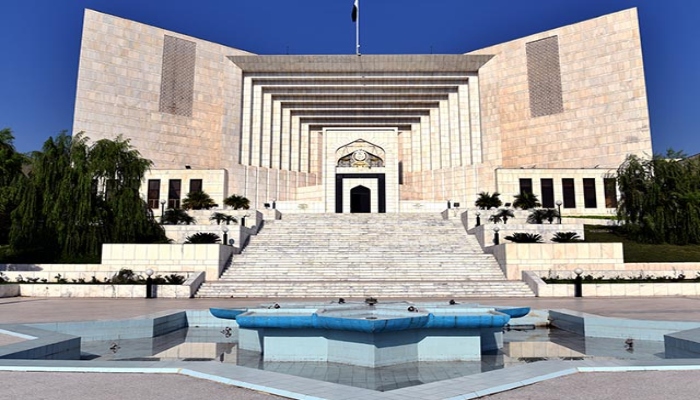
The Supreme Court’s larger bench, chaired by Chief Justice P.B. Bandial and composed of Justice Muneeb Akhtar, Justice Ijaz ul Ahsan, Justice Mazhar Alam, and Justice Jamal Khan Mandokhel, resumed hearing the presidential reference seeking interpretation of Article 63(A) of the Pakistani Constitution.
Farooq H Naek, the lawyer representing the Pakistan Peoples Party (PPP), resumed his arguments and stated that while Article 58-2(b) was repealed in 1997 via the 13th Amendment, ex-President Musharraf restored it in 2002 via the LFO.
He said that it was taken out of the constitution again in 2010 by the 18th amendment.
The counsel stated that Article 63 (A) of the constitution was amended by the 14th amendment, which conferred broad powers on the party leader.
Farooq H. Naik contended that the election commission lacked the authority to overturn the party chief’s decision.
He stated that Article 63 (A) was amended again in 2002 by presidential order, reducing the party leader’s authority.
The lawyer said that the 18th amendment, which moved power from the party chief to the head of the parliamentary party, made these powers even more limited.
In the same amendment, Farooq H Naek said that the election commission had the power to make a decision on the reference filed under Article 63. (A).
He stated that Article 63 specifies the duration of a legislator’s disqualification. Counsel contended that the presidential reference was to Article 63 (A), not to its sub-clause 4.
According to Justice Ijaz ul Ahsan, Article (62) (1) (f) did not specify the period of ineligibility, and the top court interpreted it.
On four occasions, the CJP noted, Article 63 (A) has linked loyalty to party policy. He said that loyalty is an important part of the constitution, and that being disqualified isn’t very common.
According to the court, the primary purpose of Article 63 (A) is to ensure party loyalty.
“It is unnecessary to examine only Article (63)(A,” the bench stated. We must collectively peruse the constitution. “
The Hon. Justice Muneeb Akhtar observed that the holder of a party’s ticket swears allegiance to the party. As stated in their nomination papers, ticket holders pledge to adhere to the party’s policy and discipline.
Farooq H. Naek responded that no candidate can be made a slave.
According to Justice Muneeb Akhtar, violating the oath constitutes dishonesty. “The one who errs is on a political party’s ticket,” he added.
Farooq H. Naek stated that deviating from the party does not automatically disqualify one. According to a PPP lawyer, loyalty is only observed in monarchies.
Even if the member is presumed to have been unfaithful, he will still be removed from office. “Let the people choose,” he stated.
The counsel emphasised that deviation does not automatically result in disqualification.
In his statement, Justice Jamal Khan stated that harsh penalties such as disqualification cannot be imposed without a trial. He also said that an independent candidate who later joins a party doesn’t have to swear an oath of allegiance to the party.
Farooq H. Naek concluded his arguments by stating that the dissenter can only be removed from office and then contest the by-election.
The case has been continued until Thursday.