


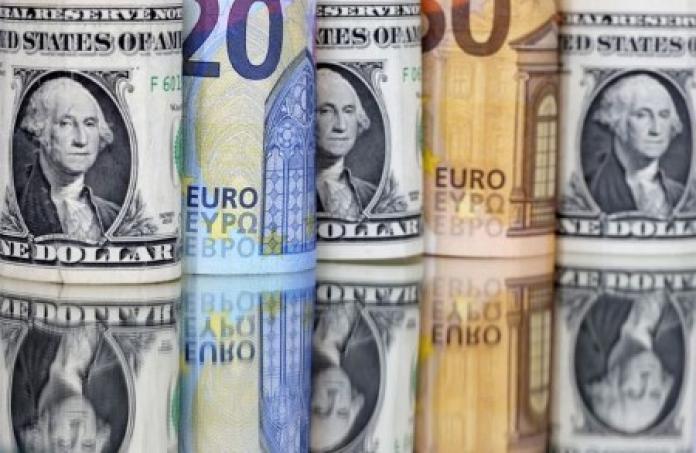
TOKYO On Monday, the euro rose to its highest level against the dollar in more than three weeks, and the value of the pound rose to its highest level this month. This happened as European Central Bank officials pushed for more aggressive monetary tightening.
Before important U.S. inflation data this week, which could give the Federal Reserve room to slow the pace of rate hikes at its Sept. 21 policy meeting, the greenback was sitting close to a two-week low against a basket of peers.
The euro jumped as high as $1.0130 early in the Asian day before trading at $1.0079, which was 0.32 percent higher than Friday.
Sterling went up to $1.1681, and it was 0.23% higher at $1.1610, its last price.
Related: Dollar Tree lowers its earnings prediction in response to Family Dollar’s anticipated pricing cutbacks.
Sources at Reuters say there is a growing chance that the ECB will have to raise its key interest rate to 2% or more to stop record inflation in the euro zone.
In an interview with German radio over the weekend, Bundesbank President Joachim Nagel said, “Further clear steps must be taken” if the situation with consumer prices doesn’t change.
The dollar index, which compares the dollar to six major currencies, was almost the same at 108.78. It stayed close to that level after falling from Wednesday’s high of 110.79, which was the highest level in 20 years. It dropped to 108.35, which was its lowest point since August 30.
Investors are nervous about the U.S. CPI report coming out on Tuesday, even though Fed officials kept talking in a hawkish way on Friday, which was their last day to do so before a blackout period leading up to the Federal Open Market Committee’s meeting.
Fed Governor Christopher Waller said he supports “a significant increase at our next meeting,” and St. Louis Fed President James Bullard repeated his call for a 75 basis point increase.
“Officials have made it clear that the FOMC needs to keep raising interest rates until there is strong evidence that inflation is falling,” Commonwealth Bank of Australia (OTC:CMWAY) strategist Joseph Capurso wrote in a client note.
“No matter what the CPI report says, we think the FOMC has a lot more work to do,” he said. This means the dollar will go up in the short and medium terms.
The rate-sensitive yen, on the other hand, fell against the dollar by 0.36 percent to 143.215, and the dollar is now heading back toward a 24-year high of 144.99 from Wednesday.
Related: ‘Khan is prepared to compete,’ Gill said in response to the opposition’s vote of no confidence.
During trading in Tokyo, the benchmark 10-year U.S. Treasury yield, which the currency pair often follows closely, was around 3.315%, not far from last week’s nearly three-month high of 3.365%.
Over the weekend, Japanese officials again hinted that they might step in. A senior government spokesman said in an interview on a local TV station that the government must take whatever steps are needed to stop the yen from falling too much.
Analysts, on the other hand, aren’t sure that intervention would work without the Fed and other central banks’ support, since the Bank of Japan is the only developed market that is still doing stimulus.
“There needs to be a coordinated effort,” Rodrigo Catril, a strategist at National Australia Bank (OTC:NABZY), wrote in a note. “Right now, major central banks are fighting inflation by tightening policy, so it seems unlikely that the JPY will get official support from around the world.”
“If the BOJ wants to stop the JPY from falling, they need to change their ultra-easy policy,” he said. “Pressure is increasing.”
Related: Lebanon’s ‘zombie banks’ consolidate in response to the crisis.
The Australian dollar fell by 0.23 percent to $0.6831, and the New Zealand kiwi fell by 0.07% to $0.6099.
Bitcoin fell 0.4% to $21,750 after briefly reaching $22,350 for the first time since August 19. The cryptocurrency is still trying to find its footing after bouncing back from a nearly three-month low of $18,540 last week.