


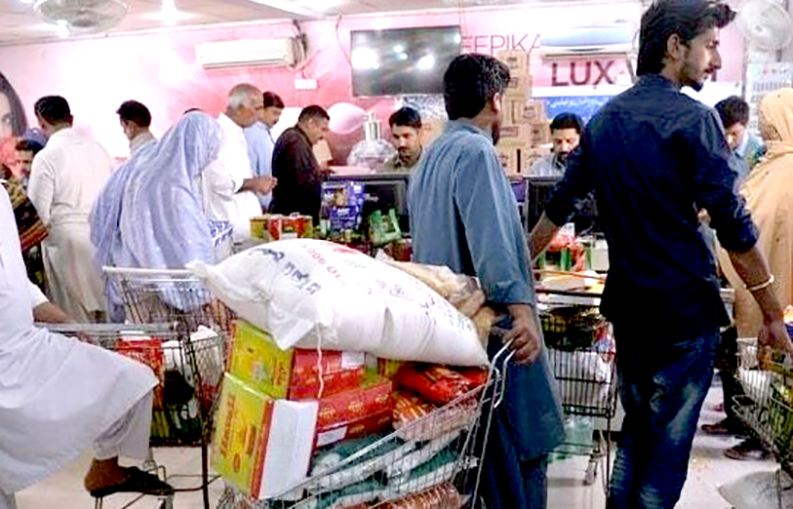
KARACHI: The food subsidy under the proposed Ehsaas Rashan Program (ERP) isn’t going to reach the people who need it because of transportation and communication issues.
It turns out that 20 million households won’t be able to get the promised Rs 1,000 a month on flour, pulses, ghee, or cooking oil. A report from the Pakistan Institute of Development Economics (PIDE) shows this.
Based on how people use the three food items in the Household Integrated Economic Survey, the study says the average monthly subsidy needed for the lowest income quintile is Rs2,048; for the second-income quintile, it’s Rs2,037; and for the third-income quintile, it’s Rs1,896. It shows that the subsidy amount only covers half of the costs for the poorest quintiles, it said.
The government announced in November 2021 that it would implement the program through Ehsaas-enabled kiryana or grocery merchants to provide the poor with subsidized food. If you want to become an ERP agent, you need an Android phone, a CNIC, a SIM card, and a bank account.
National Bank of Pakistan will manage the implementation and subsidy disbursal processes. The subsidy amount will be credited into merchants’ bank accounts in 24 hours along with a commission. The government will give the owner of the kiryana store an 8% bonus for every Rs1,000 worth of sales.
“The cost of implementing ERP is very high compared to other government programmes that do the same thing.” As part of the Ehsaas Kafaalat program, which pays ultra-poor families Rs28,000 per year per family, the government will pay the kiryana store an 8 percent commission to distribute the subsidy. This is less than 1.5 percent in the other program.
Other programmes like Ehsass Kafaalat and Utility stores Corporation also help the poor buy food and heat their homes. The proposed ERP would also help the poor meet their needs for both. This is what it said when it said that the amount of money that people get from the Ehsass Kafaalat programme isn’t enough to improve food consumption and cut poverty. When you look at how much the beneficiaries get, “it only makes up 5.3% of how much the household spends on food and other things.”
Field interviews by the PIDE team showed that more than 90% of people didn’t know about ERP. The distance to kiryana stores is a big problem for people who need help, it said. This is because the person who needs help has to pay a lot for transactions.
Android phones are used to connect to the internet and roll out ERP. The study says that smartphone ownership in rural areas is only 39% for people who are 10 years old and over. Only 44 percent of people in Balochistan own a smartphone, which is very low.
People in rural areas don’t use the internet as much as they should. There aren’t many people who own smartphones in these areas. Only 17pc of individuals reported using the internet for information-seeking purposes.
“In essence, the government needs to look at these programmes again to make sure that public resources are used efficiently and that the needs of the ultra-poor are met,” it said.