


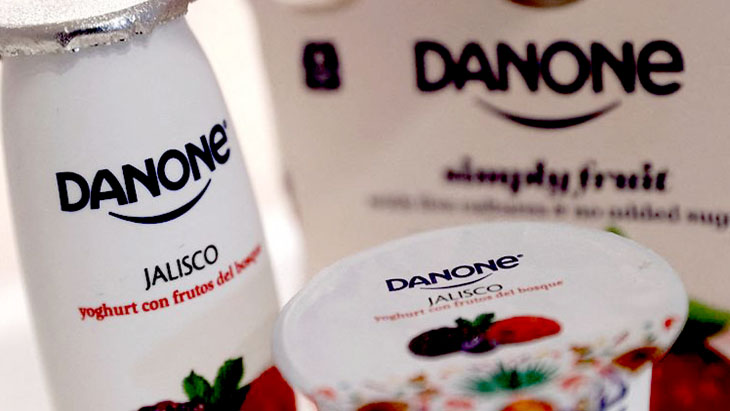
London (Reuters) – A top executive at French food company Danone told Reuters that the company is reducing the number of products it sells to retailers in order to save money. This means that yoghurt fans may not be able to find the exact flavour or size they are used to.
Supermarkets and food packagers are struggling to keep up with rising costs. A shipping shortage caused by a long pandemic and Russia’s invasion of Ukraine is making everything more expensive, from crude oil to paper food packaging.
As inflation goes up, shoppers are also cutting back on spending. Tesco (OTC: TSCDY) warned on Friday that the cost of living crisis is causing Britons to buy less, switch to cheaper own-brand products, and shop more frequently.
Some food stores had to take items off the shelves earlier this year because they could no longer afford to sell them.
Because of these things, one of the best food companies in the world is rethinking how it sells its best-selling products, like Activia yoghurt and Evian water.
“We need to get used to inflation, especially in Europe,” said Ayla Ziz, the head of sales for Danone around the world.
She said that the company is cutting back on “stock keeping units” (SKUs), which means that some supermarkets will have fewer flavours and sizes of Danone products.
She said that having fewer SKUs would help cut costs per type of product and that Danone was looking at its “entire portfolio” with each customer to figure out which SKUs it wanted to stop selling.
Consumer companies like Danone make many different kinds of the same product, like big and small tubs of the same yoghurt, different flavours, and value packs.
It isn’t taking an entire product line off the market, but in order to simplify its line, some of these might have to go. This is because it will be cheaper for retailers to stock and manage a smaller, less complicated inventory.
For example, supermarkets would have to spend less money on storing, keeping track of, and moving goods.
She did not say which ranges could be hit. Ziz said, “It’s not a global issue for some products.”
Maria Castroviejo, a senior analyst at Rabobank Research, said that the steps make sense for companies that want to be more efficient. At the start of the COVID-19 pandemic, a lot of companies did the same thing.
“If you have to make a lot of small batches of different products, you have more problems and have to find more ingredients,” she said.
Danone wants to “stay competitive,” so it isn’t cutting back on promotions. Instead, it is selling fewer types of products, which will help it save on logistics costs.
Ziz said that Danone is also putting money into software that helps it price its products in a way that customers will be willing to pay.
Food companies and supermarkets have been having long discussions about prices since last year. These talks have been especially tough in Europe, where shipping costs have reached a record high.