


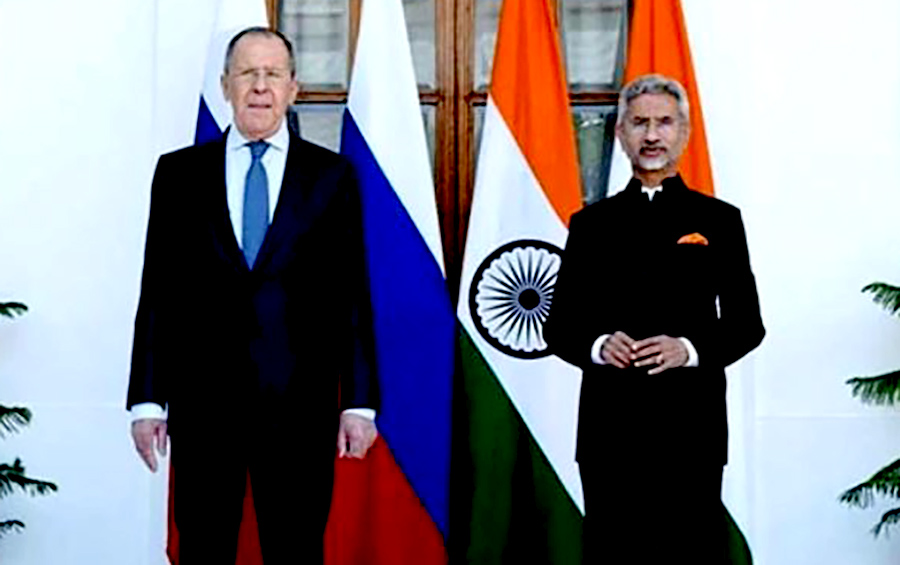
NEW DELHI: Russian Foreign Minister Sergei Lavrov met with India’s leaders in New Delhi on Friday, after a meeting with his Chinese colleague earlier in the week, as Moscow seeks to retain the Asian countries’ support in the face of Western sanctions.
Only the two Asian superpowers have not criticised Russia’s invasion of Ukraine in late February. Lavrov visited China this week, and Beijing said that it was “more resolute” to improve relations between the two countries.
“We applaud India’s approach, which takes into account all relevant facts and not just one,” Lavrov said during his opening comments at a meeting with his Indian colleague, Subrahmanyam Jaishankar.
“We are going to keep working on projects in energy, research and technology, outer space, and the pharmaceutical business.”
Lavrov’s trip comes a day after top U.S. and British officials met in New Delhi to encourage the Indian government not to undermine Western sanctions against Iran.
Daleep Singh, the United States’ Deputy National Security Adviser for International Economics, said the US would not impose any “red lines” on India’s energy imports from Russia but would not want to see a “rapid acceleration” in purchases.
Liz Truss, the British Foreign Minister, also said that she was in favour of India’s plan to buy cheap Russian oil. She also pushed for more sanctions on Russia in the ports, gold, and energy sectors.
Since the conflict began, India has purchased millions of barrels of Russian crude oil at a discount, justifying the purchases as helpful to its population, something that even European nations are doing.
Also, India has agreed to buy sunflower oil from Russia at a record-high price after Ukraine stopped shipping sunflower oil because of the war.
According to defence specialists, New Delhi cannot afford to alienate Russia, its largest weapons supplier for decades.
Russian and Indian authorities have refused to discuss Lavrov’s visit’s agenda. He was scheduled to see Prime Minister Narendra Modi on Friday evening before leaving.
There are going to be talks about a rupee-rouble payment system if the sanctions make dollar-based transactions more difficult. This could help businesses.
“We do not want to see procedures that are meant to prop up the rouble, undermine the dollar-based financial system, or bypass our financial sanctions,” US diplomat Singh told reporters on Thursday.